
A holistic approach to pediatric care in Frisco and Plano, Texas

Award winning, top rated Pediatrician serving Frisco, Plano, Allen and North Dallas


Leave a comment

FIGHT CANCER BY FIGHTING AIR POLLUTION

The International Agency for Research on Cancer (IARC) claims that 223,000 lung cancer worldwide is from air pollution. And there os also convincing evidence that air pollution increases the risk of bladder cancer. IARC reviewed thousands of studies on air pollution tracking populations over decades and classified air pollution and "particulate matter" as Group 1 human carcinogens. That ranks them alongside more than 100 other known cancer-causing substances in IARC’s Group 1, including asbestos, plutonium, silica dust, ultraviolet radiation and tobacco smoke.

The Clean Air Act requires EPA to set National Ambient Air Quality Standards for six common air pollutants. These commonly found air pollutants (also known as "criteria pollutants") are found all over the United States. They are particulate matter, ground-level ozone, carbon monoxide, sulfur oxides, nitrogen oxides, and lead. Of the six pollutants, particle pollution and ground-level ozone are the most widespread health threats.

LEARN ABOUT AQI

The AQI is an index for reporting daily air quality. It tells you about the unhealthiness of your air.

AQI of 100 or below is decent. Anything above is dangerous. AQI of 200+ is infrequent. It also changes per the seasons.
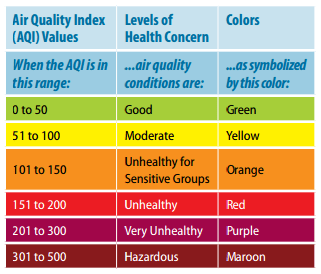
You can find about AQI value for your city at www.airnow.gov

WHO IS AFFECTED BY POOR AIR QUALITY

· People with lung diseases, such as asthma, chronic bronchitis, and emphysema, can be particularly sensitive to ozone.

· Children are at higher risk from ozone exposure because they often play outdoors in warmer weather when ozone levels are higher, they are more likely to have asthma (which may be aggravated by ozone exposure), and their lungs are still developing.

· Pregnant women.

· And Elderly adults

WHAT DOES POOR AQI DO?

· Irritate the respiratory system

· Reduce lung function

· Cause lung tumors

· Aggravate Asthma

· Make lungs susceptible to lung infection

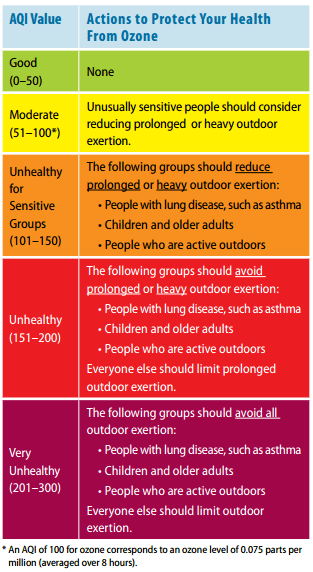
WHAT CAN YOU DO TO PROTECT?
OTHER RESOURCES:

State Air Quality Resources
American Lung Association (ALA) of Texas
Inter-Tribal Environmental Council
Outdoor Burning in Texas
Quemar al Aire Libre en Texas
Texas Air Quality Index Program
Texas Commission on Environmental Quality (TCEQ)
Texas Commission on Environmental Quality (TCEQ) – Air Quality
Texas Commission on Environmental Quality (TCEQ) Contacts
Compare county level air quality: http://www.epa.gov/aircompare/compare.htm
Today’s Ozone Forecasts

Source: EPA, Reuters and Others


Leave a comment

NEWS FLASH: E-CIGARETTES REPLACING DRUGS

First the good news:

Drug use among America’s youth is dropping. The rate of illicit drug use among children and teenagers 12 to 17 years old dropped to 9.5 percent, down from 11.6 percent a decade earlier, according to the Substance Abuse and Mental Health Services Administration’s (SAMHSA) latest national survey.

Then the Bad:

However electronic cigarettes are gaining favor among U.S. teenagers. Per CDC, last year, 10% of high school students say they tried e-cigarettes, according to the National Youth Tobacco Survey. It seems to be fueled by an uptick of slick new marketing, which includes celebrities including Jenny McCarthy, Stephen Dorff and Courtney Love for the pitches. E-cigarette advertising, unburdened thus far by regulation, has ballooned from zero in 2008 to $3.7 million in 2011 and $19.9 million last year.

E-cigarettes heat a solution containing nicotine, which is derived from tobacco leaves, into a vapor that users inhale. An electronic cigarette can contain as much nicotine as a regular cigarette — or more. The amount of nicotine an electronic cigarette delivers depends on the content of the liquid-nicotine cartridge installed in it. Many e-cig manufacturers sell the products online, along with the required cartridges, batteries and other accessories.

Studies so far are mixed. Some cite potential hazards, including a secondhand effect from the vapor, and a small Greek study last year said e-cigarettes may damage the lungs. Cobb, the Georgetown pulmonologist, says because almost all are imported from China, there have quality-control issues, contamination concerns and widely varying nicotine levels. Some individuals, particularly those with health conditions that make them sensitive, have reported that the vapor is irritating to their eyes, noses and throats, and that it affects their breathing and makes them nauseous. The FDA is in the process of having e-cigarettes labeled as a drug-delivery device so they can be regulated [source 1=”FDA” language=”:”][/source]. Regulations vary, but some countries, including Australia, Canada, Israel and Mexico, have banned electronic cigarettes [source language=”:NPR”][/source].

TAKEAWAY: Don’t underestimate the long-term effects of these novel tobacco products. Avoid them and teach your kids to avoid them.

Source: multiple including CDC, howstuffworks.com and USAToday.com