
A holistic approach to pediatric care in Frisco and Plano, Texas

Award winning, top rated Pediatrician serving Frisco, Plano, Allen and North Dallas


Leave a comment

The future jobs for our kids

Came across an insightful article about the future of jobs for our kids. This goes to the social wellbeing of our kids. Read and ruminate.

Need a Job? Invent It

By THOMAS L. FRIEDMAN

Published: March 30, 2013

WHEN Tony Wagner, the Harvard education specialist, describes his job today, he says he’s “a translator between two hostile tribes” — the education world and the business world, the people who teach our kids and the people who give them jobs. Wagner’s argument in his book “Creating Innovators: The Making of Young People Who Will Change the World” is that our K-12 and college tracks are not consistently “adding the value and teaching the skills that matter most in the marketplace.”

This is dangerous at a time when there is increasingly no such thing as a high-wage, middle-skilled job — the thing that sustained the middle class in the last generation. Now there is only a high-wage, high-skilled job. Every middle-class job today is being pulled up, out or down faster than ever. That is, it either requires more skill or can be done by more people around the world or is being buried — made obsolete — faster than ever. Which is why the goal of education today, argues Wagner, should not be to make every child “college ready” but “innovation ready” — ready to add value to whatever they do.

That is a tall task. I tracked Wagner down and asked him to elaborate. “Today,” he said via e-mail, “because knowledge is available on every Internet-connected device, what you know matters far less than what you can do with what you know. The capacity to innovate — the ability to solve problems creatively or bring new possibilities to life — and skills like critical thinking, communication and collaboration are far more important than academic knowledge. As one executive told me, ‘We can teach new hires the content, and we will have to because it continues to change, but we can’t teach them how to think — to ask the right questions — and to take initiative.’ ”

My generation had it easy. We got to “find” a job. But, more than ever, our kids will have to “invent” a job. (Fortunately, in today’s world, that’s easier and cheaper than ever before.) Sure, the lucky ones will find their first job, but, given the pace of change today, even they will have to reinvent, re-engineer and reimagine that job much more often than their parents if they want to advance in it. If that’s true, I asked Wagner, what do young people need to know today?

“Every young person will continue to need basic knowledge, of course,” he said. “But they will need skills and motivation even more. Of these three education goals, motivation is the most critical. Young people who are intrinsically motivated — curious, persistent, and willing to take risks — will learn new knowledge and skills continuously. They will be able to find new opportunities or create their own — a disposition that will be increasingly important as many traditional careers disappear.”

So what should be the focus of education reform today?

“We teach and test things most students have no interest in and will never need, and facts that they can Google and will forget as soon as the test is over,” said Wagner. “Because of this, the longer kids are in school, the less motivated they become. Gallup’s recent survey showed student engagement going from 80 percent in fifth grade to 40 percent in high school. More than a century ago, we ‘reinvented’ the one-room schoolhouse and created factory schools for the industrial economy. Reimagining schools for the 21st-century must be our highest priority. We need to focus more on teaching the skill and will to learn and to make a difference and bring the three most powerful ingredients of intrinsic motivation into the classroom: play, passion and purpose.”

What does that mean for teachers and principals?

“Teachers,” he said, “need to coach students to performance excellence, and principals must be instructional leaders who create the culture of collaboration required to innovate. But what gets tested is what gets taught, and so we need ‘Accountability 2.0.’ All students should have digital portfolios to show evidence of mastery of skills like critical thinking and communication, which they build up right through K-12 and postsecondary. Selective use of high-quality tests, like the College and Work Readiness Assessment, is important. Finally, teachers should be judged on evidence of improvement in students’ work through the year — instead of a score on a bubble test in May. We need lab schools where students earn a high school diploma by completing a series of skill-based ‘merit badges’ in things like entrepreneurship. And schools of education where all new teachers have ‘residencies’ with master teachers and performance standards — not content standards — must become the new normal throughout the system.”

Who is doing it right?

“Finland is one of the most innovative economies in the world,” he said, “and it is the only country where students leave high school ‘innovation-ready.’ They learn concepts and creativity more than facts, and have a choice of many electives — all with a shorter school day, little homework, and almost no testing. In the U.S., 500 K-12 schools affiliated with Hewlett Foundation’s Deeper Learning Initiative and a consortium of 100 school districts called EdLeader21 are developing new approaches to teaching 21st-century skills. There are also a growing number of ‘reinvented’ colleges like the Olin College of Engineering, the M.I.T. Media Lab and the ‘D-school’ at Stanford where students learn to innovate.”

Leave a comment

30 DR. SEUSS QUOTES THAT CAN CHANGE YOUR LIFE

I love Dr. Seuss. So when I saw this, I knew you will enjoy them too. Share with your kids.

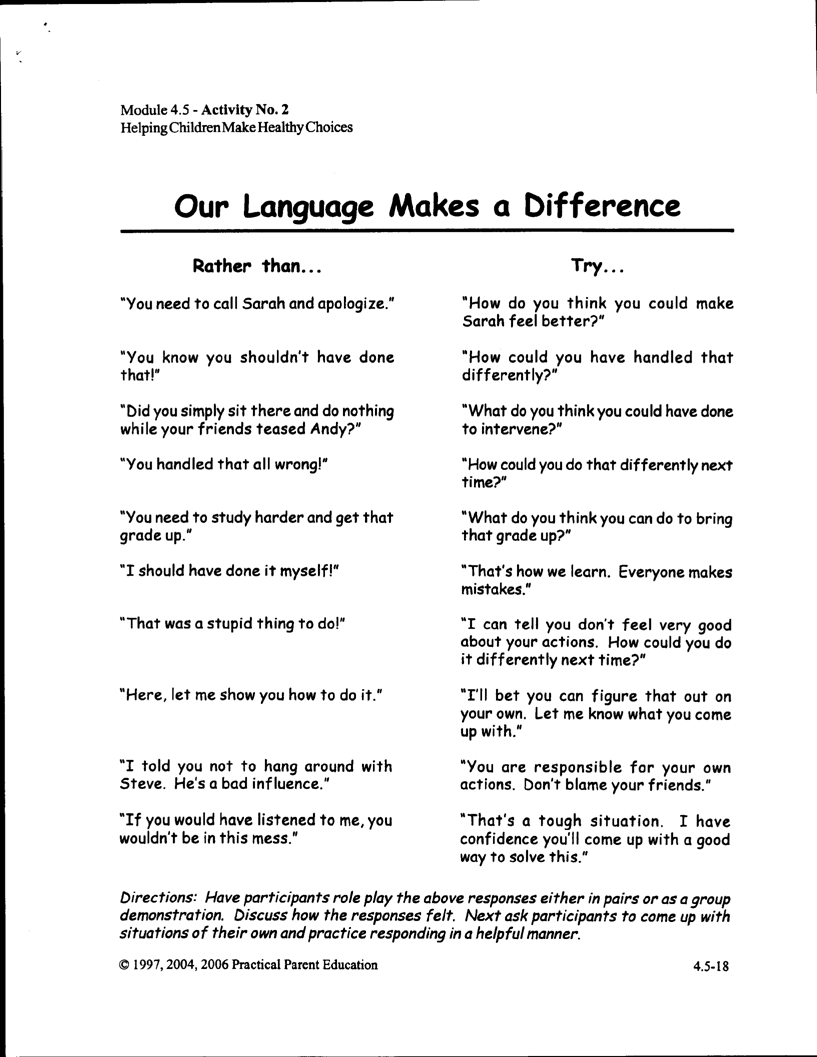
PARENTING: A YOGA OF THE TONGUE

Leave a comment


Leave a comment

DEVELOPING YOUR CHILD’S CHARACTER

I came across this beautiful set of words on a parent’s role in building a child’s character

Hope you enjoy it.

Begin with Yourself

· Look inward

· Walk-the-Walk and Talk the Talk

· Treat your child as a person, with love and respect

Provide Leadership

· Share your Values

· Set Firm, consistent guidelines

· Hold child accountable for their actions

· Praise effort, not results

· Know that he/she won’t always get it right


Leave a comment

“WHEN YOU THOUGHT I WASN’T LOOKING”

Go this from a friend of ours and thought it was a beautiful sentiment to share with parents.

If you are a parent and wonder where it’s all going, we hope the following words give you peace …

WHEN YOU THOUGHT I WASN’T LOOKING

When you thought I wasn’t looking,

I saw you hang my first painting on the refrigerator,

and I wanted to paint another one.

When you thought I wasn’t looking,

I saw you feed a stray cat,

And I wanted to be kind to animals.

When you thought I wasn’t looking,

I saw you make my favorite cake for me,

And I knew that little things are special things.

When you thought I wasn’t looking,

I heard you pray

And I knew there is a God I could always talk to.

When you thought I wasn’t looking,

I felt you kiss me goodnight,

And I felt loved.

When you thought I wasn’t looking,

I saw the tears you shed,

And I learned that sometimes things hurt,

but it’s all right to cry.

When you thought I wasn’t looking,

I saw that you cared

And I wanted to be everything that I could be.

When you thought I wasn’t looking,

I saw you react graciously to the difficulties in life,

And I saw that I could do the same and still have joy.

When you thought I wasn’t looking,

I saw you forgive over and over again,

And I learned the value of forgiveness.

When you thought I wasn’t looking,

I heard you praying for me,

And I learned how to do it too.

When you thought I wasn’t looking,

I saw you sacrificing to give to others,

And I learned that you truly gain from giving.

When you thought I wasn’t looking,

I saw you healing hurts and calming fears,

And now I know how to do it with others.

When you thought I wasn’t looking,

I learned so many lessons about how to love and give,

And these now bring blessings to me every day.

When you thought I didn’t notice,

I saw all the many times you loved and sacrificed,

And I realized that you are the proof that God exists.

When you thought I wasn’t looking,

I looked …

And wanted to say thanks for all the things I saw,

When you thought I wasn’t looking.

Author: Mary Rita Schilke Korazan


Leave a comment

LIFE LESSON FOR TEENS

  1. Don’t Drink or text and Drive: Car crashes are the leading cause of death for US teens, according to the CDC. In fact, 12 kids age 16-19 die every day from accident-related injuries. Dangerous driving behaviors—like drinking (obviously), but also texting/calling, and having multiple passengers in the car—play a big role in these shocking numbers. Lead by example—don’t let your kids see you fumbling around in your purse to answer your ringing phone when you’re at the wheel.
  2. Tell your kids that it’s OK to worry: And make sure your kids know that you’re there for them. Check in with your kids frequently about whatever may be going on—whether it’s bullying, virus fears or someone losing a job—to see how they’re feeling, and explain how your family is dealing with it.
  3. Teach your child to love his/her body: Studies routinely find that about 40% of elementary school girls and 25% of elementary school boys are dissatisfied with their bodies. Unhappy and self-conscious kids report more frequent feelings of depression, insecurity, and anxiety. Thwart unhealthy body image and counter the media images that bombard your kids by talking to them.
  4. Help them get sleep: More than 25% of the kids surveyed (between 11 and 17 years old) had one or more symptoms of insomnia—and were much likelier to use drugs, experience depression, or have problems with school work, jobs and perceived health. Set a technology curfew with your kids, and make sure they understand why. Shut off the TV and have your children stop using phones and computers at least an hour before bed.
  5. Be smart about the web: If your kid’s active online, ask to see her social network profile(s)—and tell her not to post anything that you, a teacher, or a college recruiter shouldn’t view.
  6. Maintain an open line of communication so the big chat isn’t such a big deal. If your kid comes to you and asks about sex, turn the question back, and ask her what she knows, or what she means, by the term. Also reiterate family values into conversations about intimacy and sex.
  7. Value Friendship: It’s not about being the most popular kid on the playground. Having one or two best friends is more closely correlated with staving off depression and loneliness than is overall popularity.
  8. Be grateful: Research suggests that grateful people have more energy and optimism, are less bothered by life’s hassles, are more resilient in the face of stress, have better health, and suffer less depression than the rest of us.


Source: http://www.prevention.com

RAISING HEALTHY KIDS – INTERACTIVE WEB RESOURCE FROM AAP

Leave a comment


Leave a comment

RAISING HEALTHY KIDS

  1. Eating Pesticide free food: In 2012 AAP recommends that feed your children a healthy variety of fruits and vegetables. If you can’t afford to buy everything organic, consider the Environmental Working Group’s “dirty dozen.” It lists the produce with the most pesticide residue—and thus the ones most worth getting organic whenever possible.
  2. Be strict about bedtime: kids aren’t getting enough sleep, which leads to trouble at school. Setting the limits that help them establish good sleep habits now will set them up for success. encourage a period of winding down prior to bed—for little kids that could be a bath and a story, while for older ones, it means turning off the stimulating TV shows or video games.
  3. Limit screen time: AAP discourages parents from allowing any screen time at all for children under 2 (in favor of more interactive play). But for older children, they are OK with no more than one to two hours a day of screen time—as long as the content is non-violent and educational in nature.
  4. Allow some snacking between meals: with obesity rates on the rise, even among toddlers, you need to be careful what you give your kids to snack on, and when they eat it. Think low-calorie, low-fat and in small portions. Don’t be afraid to offer a fruit or vegetable and say, ‘This is today’s snack, take it or leave it.’
  5. 5 second rule: The San Diego State University study found that the most germ-laden surface was the kitchen counter, followed by tile floors and then carpets. So if you’re worried about bacteria, start by disinfecting your kitchen surfaces, then work on the floors.
  6. Complaining: Kids of all ages take in more than you may think. And if what they’re hearing constantly how much weight you need to lose don’t be surprised when your 10-year-old daughter tells you she’s going on a diet.
  7. Helicopter parenting: Hovering over your children every minute doesn’t allow them the space they need to develop independence and other important skills. Of course you want to protect your kids, but allowing them to fall down or make some mistakes can be a valuable learning experience. Just be ready with a kiss and Band-Aid to make it all better.
  8. Social Media: Sharing specific details about your children—including their full names, photos and any identifying information about where you live or where they attend school—could give potential Internet predators too much information. Also, remember that things posted online tend to live forever.
  9. Eating or Sipping Milk in Bed: If your child still downs a bottle or sippy cup of milk prior to bed, help prevent cavities by brushing or wiping off his teeth before putting him into the crib.
  10. Beware of BPA: The evidence against this chemical—found in many plastics as well as the linings of food cans—continues to pile up, and much of it relates to the hazards of babies and children being exposed to it. Possible health risks may include disruption of hormones, behavioral problems, heart disease and even cancer. And while the chemical was removed from many baby products—like bottles and sippy cups—try to limit the number of plastic toys and other things that your kids usually chew on.
  11. Positive Feedback: Children do best when they receive calm and consistent feedback and assertive discipline that’s based on reasonable expectations – with significantly more encouragement and positive feedback than criticism.
  12. Five steps to Positive Parenting:

01. Create a safe, interesting environment

02. Have a positive learning environment

03. Use assertive discipline

04. Have realistic expectations

05. Take care of yourself as a parent

Also remember to praise specific effort rather than results.

Source: http://healthyliving.msn.com